
Prove it holds — to 1.5× operating pressure.
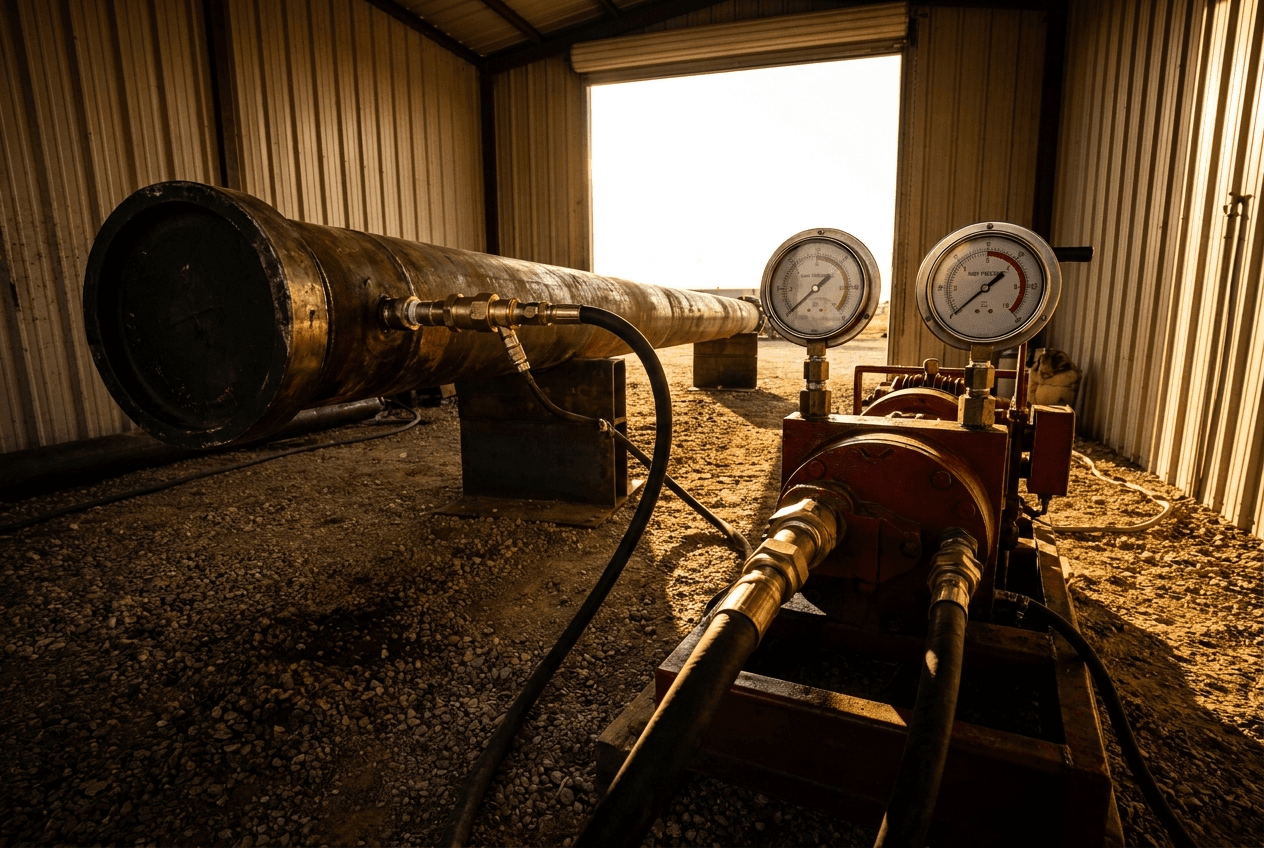
Pipe hydrotesting is a proof test used to verify the pressure-holding capacity and leak-tightness of a pipe by pressurizing it with water. It validates that an entire piping system is structurally sound and leak-tight for daily use — the industry baseline standard, and how we cover the pressure-testing side of the job.
What You Get
Pipe Hydrotesters, done right.
Fill, bleed & pressurize
Pipe filled with water, air bled out, pressurized to ~1.5× design pressure.
Validate structural strength
Confirms the pipe can handle its maximum operational limit.
Confirm leak-tightness
Checks the full system for pressure drops and visible leaks.
Pass / fail proof
A clear pass/fail result on the entire piping system.
Industry baseline
The standard test that proves a system is ready for daily use.
How It Works
The pipe is entirely filled with water, air is bled out, and the system is pressurized to roughly 1.5 times its design operating pressure. Operators then check for pressure drops or visible leaks to confirm the system holds.
The Upside
The industry baseline that proves an entire piping system is structurally sound and leak-tight before it goes into daily service.
Good To Know
It won’t tell you why a pipe failed until it actually bursts or leaks, and can miss hidden cracks or corrosion that haven’t yet penetrated the wall — which is why EMI scanning first matters.
✦ Straight Answers ✦
Pipe Hydrotesters questions, answered
What pressure do you test to?
Roughly 1.5 times the pipe’s design operating pressure — the industry-standard proof test. We fill with water, bleed the air, pressurize, and watch for pressure drops or visible leaks.
Why hydrotest if the pipe was already scanned?
They answer different questions. The EMI scan maps the pipe’s condition — wall loss, rod-wear, corrosion. The hydrotest proves the assembled system actually holds pressure. Scan first, then hydrotest: that is how you put pipe downhole with real confidence.
Is hydrotesting safe?
Water is used precisely because it barely compresses — a failure releases far less energy than testing with air or gas. And because we scan pipe before high-pressure tests, dangerous hidden defects get caught before they can rupture.
How do I schedule a hydrotest?
Call Julia at 432-599-6791 or email jrios.tts@gmail.com with pipe size, footage, and location — we will get you on the schedule and quote it straight.
Also From TTS
Our other service
Need pipe hydrotesters on your pipe? Reliable equipment, accurate results — get in touch and we'll schedule it.
Request an Inspection