
EMI inspection — see inside the pipe without cutting it open.
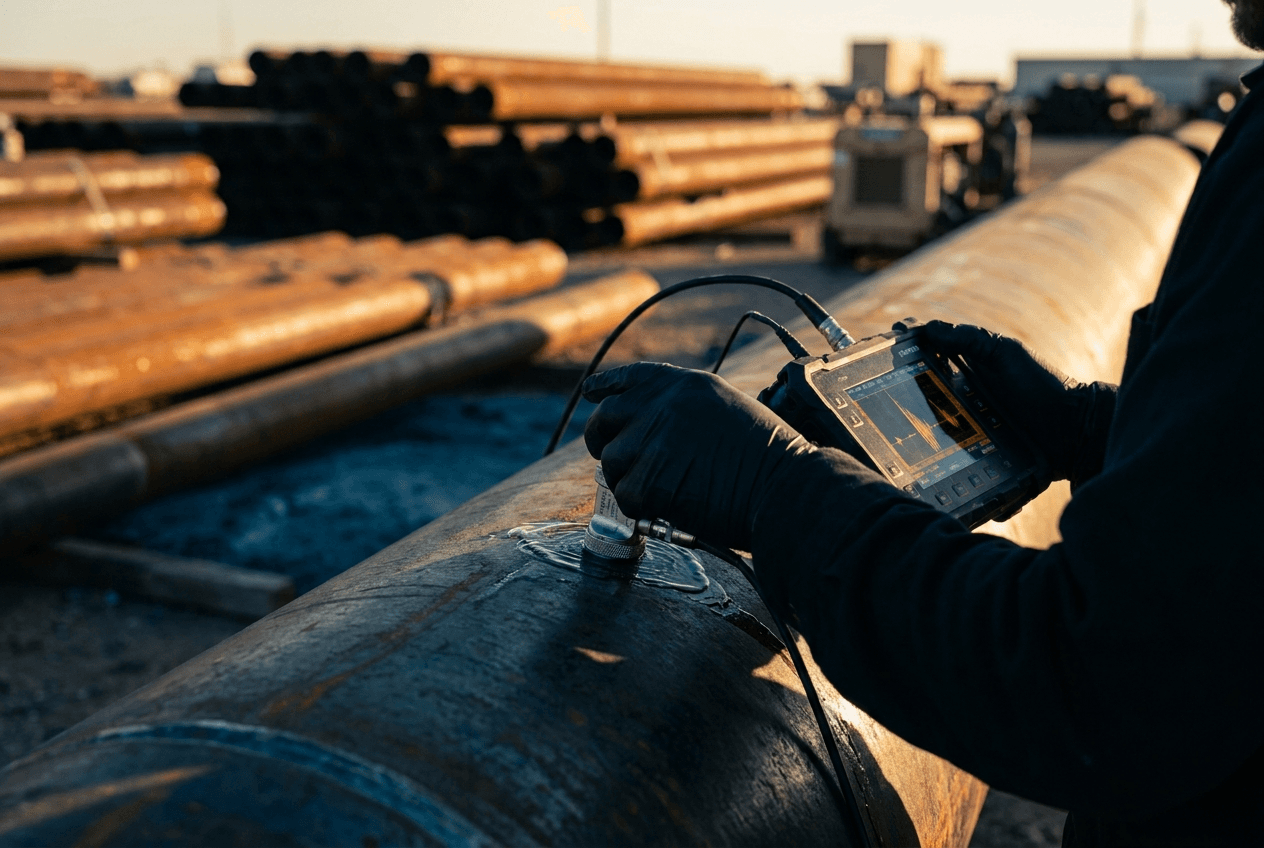
Our pipe scanning uses Non-Destructive Testing (NDT) — electromagnetic inspection (EMI) — to evaluate tubing without damaging it. Using non-contact magnetic principles, the system scans right through interfering fluids, wax, and sand debris, monitoring the magnetic fields around and within the tubing to detect rod-wear, corrosion, pitting, and wall loss.
What You Get
Pipe Scanners, done right.
Non-contact magnetic scanning
Scans through fluids, wax, and sand debris — no cleaning required.
Rod-wear & corrosion detection
Reads the magnetic fields around and within each tube.
Wall-loss measurement
Four wall-loss indicators plus a total-wall measurement per joint.
Trace record per joint
A trace-like record of each tube and a profile of the whole string.
Fast wellhead inspection
Inspection rates up to 200 ft/min, with electronics up to 120 ft away.
What We Inspect
Two inspections, one standard
Wellhead Tubing EMI Inspection
Non-contact EMI scanning of production tubing right at the wellhead — filtering out fluids, wax, and sand to read rod-wear, corrosion, and wall loss, then outputting a trace record of every joint plus a full-string profile.
- 2 flaw channels + split measurement
- 4 wall-loss indicators + total-wall measurement
- Inspection rates up to 200 ft/min
- Tubing sizes: 2 3/8", 2 7/8", 3 1/2"
Tubular Inspections
Mobile inspection of oilfield tubulars and drill pipe — we bring calibrated EMI equipment to your yard or location and grade tubing condition joint by joint before it goes back in service.
- Mobile — we come to your yard or location
- Production tubing & drill pipe
- Joint-by-joint condition grading
- Calibrated, certified equipment
How It Works
As tubing runs through the inspection head at up to 200 ft/min, the electronics analyze the magnetic response and generate a trace-like record of each individual tube and a profile of the entire string — a clear, joint-by-joint picture of pipe condition on a laptop, right at the wellhead.
The Upside
A complete, joint-by-joint map of tubing condition without damage — so you catch worn, corroded, or thin pipe before it fails downhole.
Good To Know
EMI reads magnetic pipe condition — a hydrotest is still how you prove a joint holds pressure, which is exactly why the two work together.
✦ Straight Answers ✦
Pipe Scanners questions, answered
Do I have to clean or drain the tubing before an EMI scan?
No. Our non-contact magnetic system scans right through fluids, wax, and sand debris — which is exactly what makes EMI practical at the wellhead, without the downtime of cleaning every joint first.
What tubing sizes can you inspect?
We inspect 2 3/8", 2 7/8", and 3 1/2" tubing — the workhorse sizes of the Permian — at rates up to 200 ft/min, right at the wellhead or at your yard.
What do I actually get after the inspection?
A trace-like record of every individual tube plus a profile of the whole string — flaw locations, wall-loss data, and a clear joint-by-joint picture of what should go back downhole and what should not.
Can you come to my location?
Yes — our tubular inspection is mobile. We bring calibrated, API-certified EMI equipment to your wellhead, yard, or location anywhere in the Permian Basin. Call 432-599-6791 to schedule.
Also From TTS
Our other service
Need pipe scanners on your pipe? Reliable equipment, accurate results — get in touch and we'll schedule it.
Request an Inspection